Before moving from Nigeria to Canada, I researched packing, food, winter, flights, hospitals, what to buy and what life might be like. Some answers were useful, while others were scattered or misleading.
What I Researched Before Moving From Nigeria to Canada And What I Couldn’t Find Clearly
Before I moved from Nigeria to Canada, I had questions about almost everything.
What should I pack?
What should I buy before leaving Nigeria?
What am I not allowed to carry into Canada?
Should I bring food?
What will I eat when I arrive?
How cold is Canada really?
Which airline should I use?
Where will I stop during the journey?
What will the flight be like?
What things are actually expensive in Canada?
And what will everyday life feel like when I finally get there?
I was writing things down in a notebook and gradually building my own preparation list.
At the same time, I was searching online.
I checked YouTube.
I checked TikTok.
I checked Instagram.
I searched for people’s experiences and tried to put all the information together myself.
Some of what I found helped me.
Some of it did not.
And after eventually arriving in Canada, I realized there were things I had spent too much time worrying about, things I had unnecessarily bought in Nigeria and other things I wished somebody had explained more clearly.
That experience is one of the reasons I believe preparing to relocate should involve more than simply watching random videos and copying somebody else’s packing list.
My Research Started With Very Basic Questions
When you have never relocated internationally before, even simple questions can feel important.
I was not only researching visas and school.
I was researching normal life.
What do people eat?
What should I wear?
What happens during winter?
Which things from Nigeria will be difficult to find?
What should go inside my luggage?
What should stay behind?
What kind of flight should I book?
Should I worry about the country where I will transit?
These were the kinds of things I was writing in my notebook.
I wanted to feel prepared.
Looking back now, I think that instinct was good.
The problem was that the information was everywhere.
One person would say one thing on TikTok.
Another person on YouTube would say something completely different.
Then somebody else on Instagram would make an item sound impossible to find in Canada.
When you have never been to the country yourself, you do not yet have enough experience to know which advice deserves your attention.
I Researched What to Pack From Nigeria to Canada
Packing was one of the biggest areas I researched.
I wanted to know what Nigerians normally carried when moving to Canada.
Food came up constantly.
Clothing came up.
Hair products and equipment came up.
Winter clothes came up.
Household items came up.
People made some things sound as though once you entered Canada, you would either never find them again or would have to spend an unbelievable amount of money.
So naturally, I tried to prepare.
After arriving, my opinion changed about some of those things.
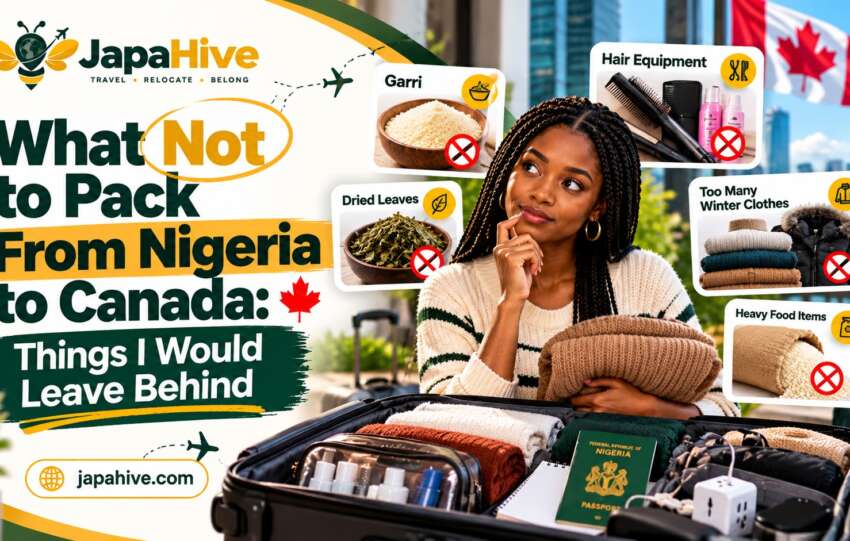
There are items I brought from Nigeria that I would not stress myself to bring again.
For example, I brought some dried leaves that I did not really find useful afterward.
I brought some hair equipment and later thought, “I could have just bought this here.”
Even garri is something I personally would not stress myself about carrying again.
Yes, buying some Nigerian foods in Canada can cost more than buying them in Nigeria.
But sometimes you also have to think about your luggage space, weight and the stress involved.
That calculation is different for everybody.
Some Nigerian Food Was Absolutely Worth It for Me
Not everything I brought was unnecessary.
There were things I was very happy to have.
I brought Nigerian spices and herbs.
I also brought dried crayfish that I had ground before travelling.
I was very happy I carried those.
That is why I do not believe in giving people one simple answer like:
“Do not bring Nigerian food.”
Or:
“Carry as much Nigerian food as possible.”
It depends on the person and the item.
What matters is knowing what you actually use.
If you barely cook with something in Nigeria, you probably do not need to carry a large quantity simply because somebody put it on a Canada packing list.
Bring things that make sense for your own life.
 But Food Is One Area Where You Must Check the Current Rules
Your personal packing preference and Canada’s border rules are two completely different things.
As of October 2026, the Canadian Food Inspection Agency says travellers bringing food into Canada must declare all food products. Whether a particular food is permitted can depend on the product itself, the country it came from and other conditions. Some items may also have quantity limits or additional requirements.
So before putting garri, crayfish, dried leaves, spices, fish products or any other food into your luggage, check the current Canadian rules for that specific item.
Do not use my suitcase as your customs guide.
What I personally carried during my journey does not automatically tell you what is permitted today.
The rules are exactly the kind of information that should come from the official source.
I Also Researched Winter Clothes Before Coming to Canada
Canadian winter was one thing I could not properly imagine from Nigeria.
I knew Canada was cold.
Everybody knows Canada is cold.
But knowing that and actually understanding what the cold feels like are very different things.
So naturally, winter clothing became part of my preparation.
I bought some winter clothes in Nigeria.
After arriving, I realized I would have preferred to buy some of those things in Canada.
That does not mean nobody should bring warm clothing.
You obviously need to think about the weather you will meet when you arrive.
What changed for me was the belief that I needed to solve my entire Canadian winter wardrobe from Nigeria.
I did not.
There are many things you can buy after arriving.
If I were preparing again, I would think more about what I genuinely need for the journey and first few days, rather than trying to buy everything before boarding the plane.
People Made Some Things Sound Much More Expensive Than I Found Them
This was another surprise.
Before travelling, I heard things about certain items being very expensive in Canada.
Hair products.
Hair equipment.
Jewelry.
Different everyday things.
Because you have never lived there before, you hear “Canada is expensive” and sometimes interpret that as “I must buy everything in Nigeria before I leave.”
Then you arrive and discover that there are different stores, online shops, sales and different price ranges.
That does not mean Canada is cheap.
It means that saying “this thing is expensive in Canada” without context is not always useful.
Expensive compared with what?
Which brand?
Which store?
What quality?
Are you buying it online?
Are you buying it on sale?
Do you even need it immediately?
Those are better questions.
 One Thing I Wish I Had Packed More Of Was My Native Wear
Interestingly, one of the things I later wished I had brought more of was not something I was panicking about before travelling.
My Nigerian native clothes.
During the warmer months, native wear can look beautiful.
After coming here, I appreciated mine differently.
If I were packing again, I would bring more of the traditional clothes I genuinely love wearing instead of filling that space with certain things I could easily replace after arrival.
That is the kind of advice I find more useful now.
Not:
“Carry this because everybody carries it.”
But:
“Carry the things that are personally valuable or difficult for you to replace.”
I Researched Flights and Transit Too
Another thing on my mind was the journey itself.
Which airline would I use?
What would my flight look like?
Which country would I stop in?
How long would the transit be?
What should I expect during a long international journey?
These questions matter when you have never made that particular trip before.
My total journey ended up being around 17 hours, with a connection where I waited roughly two to three hours before boarding the next flight.
The experience itself was fine.
But before travelling, I did not know that.
I was simply trying to picture an experience I had never had before.
If you are researching flights from Nigeria to Canada today, compare the actual route rather than looking only at the ticket price.
Check the total travel time.
Look at the number of connections.
Look at the transit duration.
Check the baggage allowance directly with the airline.
And confirm whether the transit country has any requirements that apply to your passport or itinerary.
Airline and transit rules can change, so those are things I would verify close to the actual travel date rather than rely on an old YouTube video.
Healthcare Was Another Big Question
Before travelling, I was also trying to understand how healthcare worked in Canada.
How do you go to the hospital?
What happens when you need medical care?
What is different from Nigeria?
Those questions felt especially important to me at the time.
The problem was not that there was absolutely no information online.
There was plenty.
The difficulty was putting the information into a simple answer that made sense for my own situation.
That is one thing I now understand about relocation research.
Sometimes the problem is not lack of information.
It is too much information without enough context.
You can watch ten videos and still not know which answer applies to you.
Healthcare is also an area where province, immigration status, school insurance and personal circumstances can matter, so I would never tell somebody to rely on another newcomer’s experience as their full healthcare plan.
Check what applies to your own situation before travelling.
I Was Also Researching What Everyday Life Would Feel Like
Some questions cannot really be answered by an official government page.
What will it feel like to live there?
Will I like the environment?
How difficult is the cold?
What should I expect as a newcomer?
Will things feel lonely?
How quickly will I adjust?
Those were questions I also had.
And these are exactly the areas where other people’s experiences can actually be useful.
An official website can tell you a rule.
A person who has relocated can tell you what surprised them.
You need both.
I think I sometimes expected that because I had researched so much, I would feel completely prepared when I arrived.
That is not how relocation works.
You can research a place for months and still experience things differently when you are actually living there.
What I Couldn’t Find Clearly Before Moving
Looking back, there were several things I wish had been explained more simply.
I wish somebody had clearly separated:
What you genuinely need to bring from Nigeria
from
What you can easily buy after arriving.
I wish there had been more context around:
“Canada is expensive.”
Expensive in what way?
Which items?
Compared with where?
Do you need to buy them immediately?
I wish more relocation content had explained that not everything deserves space in your suitcase.
And I wish people talked more about the difference between preparing for entry into Canada and preparing for everyday life after you arrive.
Those are different things.
You can be perfectly prepared for the airport and still have no idea how you are going to organize your first normal week.
My Biggest Research Mistake Was Treating Every Piece of Advice as Equally Important
When you are new to relocation planning, almost everything sounds urgent.
Somebody says:
“Make sure you carry this.”
You write it down.
Another person says:
“Buy this before you leave because it is too expensive abroad.”
You add it to the list.
Someone else says:
“You will regret it if you don’t bring this.”
Now you are worried.
But advice needs context.
What worked for a family of five may make no sense for one student.
What someone needed ten years ago may now be available easily online.
What was expensive when somebody moved may now have cheaper alternatives.
And what somebody loves using may be completely irrelevant to your lifestyle.
If I were preparing again, I would ask one question much more often:
“Do I personally need this?”
How I Would Research Moving to Canada Differently Today
I would divide my research into three groups.
First, official information.
This includes immigration rules, border restrictions, documents, school requirements and anything where getting the answer wrong could create a serious problem.
Second, practical firsthand experience.
This is where blogs, YouTube, TikTok, Reddit, forums and other people’s stories can be helpful.
Things like what surprised them, what they regretted packing, how they found accommodation or what their first winter felt like.
Third, my own circumstances.
This is the category people sometimes forget.
After gathering everybody else’s advice, ask whether it actually applies to you.
Your budget.
Your program.
Your family.
Your lifestyle.
Your airline.
Your arrival season.
Your luggage allowance.
Your personal needs.
That final filter can save you a lot of unnecessary stress.
A Simple Research Checklist Before Moving From Nigeria to Canada
If you are currently preparing to move from Nigeria to Canada, these are the areas I would research before departure:
Your immigration documents
Know what documents you are expected to travel with and check the current requirements through IRCC.
Your school information
Know your start date, campus, important deadlines and who to contact if something changes.
Your flight
Check the route, total travel time, connection, transit requirements and baggage allowance directly with the airline.
What you can legally bring into Canada
Especially food, plant products and animal products. Canada requires travellers to declare food, and restrictions can depend on the item and country of origin.
What you genuinely need to pack
Do not let another person’s suitcase become your shopping list.
Weather at the time you arrive
Preparing for January is not the same as preparing for July.
Healthcare and insurance
Understand what coverage you will actually have.
Accommodation
Know where you are going after leaving the airport.
Money and banking
Think about how you will access money during your first days.
Phone and internet
Know how you will communicate after landing.
Transportation
Research how you will get from the airport and how people normally move around your destination.
You do not need to know every detail of Canadian life before boarding the plane.
But you should know enough to make your first days easier.
Questions People Often Ask Before Moving From Nigeria to Canada
What should I research before moving to Canada from Nigeria?
Start with immigration documents, school information if you are a student, flights, baggage, accommodation, weather, healthcare, money, transportation, phone service and what you are legally allowed to bring into Canada.
What should I pack from Nigeria to Canada?
There is no perfect universal packing list. My own experience taught me to prioritize things I genuinely use and value rather than copying everything other travellers recommend.
Should I bring Nigerian food to Canada?
That depends on what you use, your luggage space and whether the food is currently allowed into Canada. The Canadian Food Inspection Agency requires travellers to declare all food they bring and advises checking the requirements for individual products before travelling.
Should I buy winter clothes in Nigeria before moving to Canada?
I bought some before travelling and later felt I would have preferred buying more of my proper winter clothing after arriving. Your arrival season still matters, so make sure you have enough suitable clothing for the weather you will meet immediately.
Is everything very expensive in Canada?
Canada can be expensive, but broad statements like “everything is expensive” are not very useful when deciding what to pack. My own experience was that some items people made sound extremely expensive were available at different prices once I arrived.
Where should I get information about moving to Canada?
Use official sources for rules and requirements. Use firsthand experiences for practical insight. Then decide what actually applies to your own circumstances.
What I Want You to Remember
If you are searching Google, ChatGPT, Gemini or YouTube for what to know before moving from Nigeria to Canada, you will find more information than you can possibly use.
The challenge is not collecting the biggest amount of information.
It is knowing which information matters.
Before I travelled, I researched almost everything I could think of.
Some of that preparation helped me.
Some of it caused me to carry things I did not need.
And some questions only became clear after I arrived and experienced Canada for myself.
So research, absolutely.
But do not let research turn into panic buying, overpacking or believing every person’s experience must become your own.
Check official rules where rules matter.
Learn from people’s experiences where experience matters.
And when someone gives you a long list of things you “must” carry to Canada, ask yourself one more question before putting it in your suitcase:
Do I actually need this?
Last verified for current Canadian food import guidance: October 2026.
Previous article: How IELTS Became Part of My Canada Study Journey From Nigeria